
Building Te Ara Whetū: Sustainability in action
18 May 2026
The construction of Te Ara Whetū, the new library hub for Waikanae on the Kāpiti Coast, is implementing industry-leading sustainability practices that place environmental responsibility at the heart of the project.
The original Waikanae build was closed in November 2018 due to poor air quality. Kāpiti Coast District Council undertook extensive multi-year community engagement which confirmed refurbishing and extending the original site was the right approach.
Council’s mana whenua partners Te Ātiawa ki Whakarongotai have been involved from the start, gifting the building’s name Te Ara Whetū - the passage of stars from the mountains to the sea. The name reflects its location in Mahara Place, nestled between the Tararua Ranges and the Tasman Sea.
This partnership has continued through early contractor involvement with Studio Pacific Architecture, who have ensured the cultural narrative and caring for the whenua (land) and the wai (water) have been considered.
The library design encompasses a seismic rating to 100 percent New Building Standard, strengthening the building's long-term resilience and supporting a whole-of-life sustainability approach. While sustainable building materials and passive design strategies have been considered from the outset, leading to better sustainability-focused procurement.
From a construction perspective Council was committed to seeing the sustainability principle continued encouraging lead contractor Naylor Love to work closely with Otaihanga Zero Waste to divert as much construction and demolition waste as possible away from landfill and towards reuse and recycling. This partnership reflects a shared commitment to reducing environmental impact while supporting local circular economy initiatives.
When selecting sub-contractors, Naylor Love also assesses each company's sustainability ethos, policies and track record, ensuring environmental responsibility is shared across the entire project team.
Designing sustainability in from the start
Being able to collaborate on the library design early enabled passive design strategies such as building orientation, daylight optimisation, and a well-considered façade that will all help reduce operational energy demand.
Waste reduction initiatives were built into both the design and construction phases, and low water consumption fixtures were agreed upon to further reduce potable water use across the building.
The build has also reused the existing two-storey concrete structure, which has cut embodied carbon and made use of the building's original fabric. The interior fitout reflects the same values, with a strong focus on energy-efficient lighting and HVAC systems, alongside low-VOC materials and product selections that contribute to healthier indoor environments and better overall occupant wellbeing.
Waste diversion and giving materials a second life
Throughout the project works, the building team is separating waste on site into clearly defined streams. Otaihanga Zero Waste then collects and diverts useable materials for reuse or recycling, including timber, steel and scrap metal, PVC, High-Density Polyethylene and, specifically for this project, other soft plastics, polystyrene, glass, pallets, cardboard, insulation batt offcuts and cable drums. Offcuts of gib board are transported to a specialist recycling plant in Feilding, ensuring even some traditionally hard-to-recycle materials are managed responsibly.
The results to date are significant. During the demolition phase, 94 percent of waste by weight was diverted from landfill. While diversion rates typically reduce during the construction phase due to the different materials and methods used, the project team is targeting an ongoing diversion rate of at least 75 percent — well above standard industry benchmarks for the Wellington region.
Some of the project's most tangible circular economy wins come from deliberate reuse. Shelving from the Paraparaumu Library has been retained for reuse at Te Ara Whetū, taken offsite to be modified to suit its new purpose when the hub opens. Timber sections of the structure were deconstructed by hand to enable the recovery of full-length timbers, which are being reused by a local tiny home company.
Sustainability as everyday practice
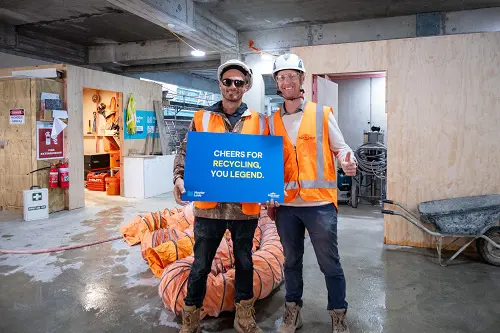
On site, sustainability expectations are reinforced through induction. Every team member receives clear guidance on how to separate, handle and store each waste stream. Regular site inspections and visits by Council staff keep the team accountable and supported and onsite signage is encouraging everyone to play their part every single day.
Between each project phase and milestone, the entire project team holds a lessons-learnt and planning session specifically focused on sustainability. There, they report and reflect on performance to help ensure the next phase runs smoothly. These sessions have also led to Naylor Love further collaborating with Studio Pacific Architects to investigate more opportunities to design out waste and developing learnings to share with the wider construction industry.
The project is also encouraging workers to carry sustainable practices beyond the building site and into their everyday routines. Several local cafés support the initiative by offering discounts to crew members who bring their Council-supplied reusable cups - a simple but effective way to reduce single-use waste while supporting local businesses.
A model for what's possible
The building of Te Ara Whetū is more than a new library hub. It’s a demonstration of how thoughtful planning, intentional partnerships and everyday actions can deliver meaningful sustainability outcomes that reflect the values of the Waikanae community and contribute to a low-waste future for the Kāpiti Coast.
A commitment from the top
Demonstrating that the commitment comes from the top, a sustainability board-signing event was held in May where Kāpiti Coast District Mayor Janet Holborow alongside Council’s partners, contractors, and subcontractors marked their shared undertaking in ink.
The signing was about pushing forward to maintain the sustainability goals, keep the momentum going and reinforce what has already been achieved keeping waste diversion rates high.